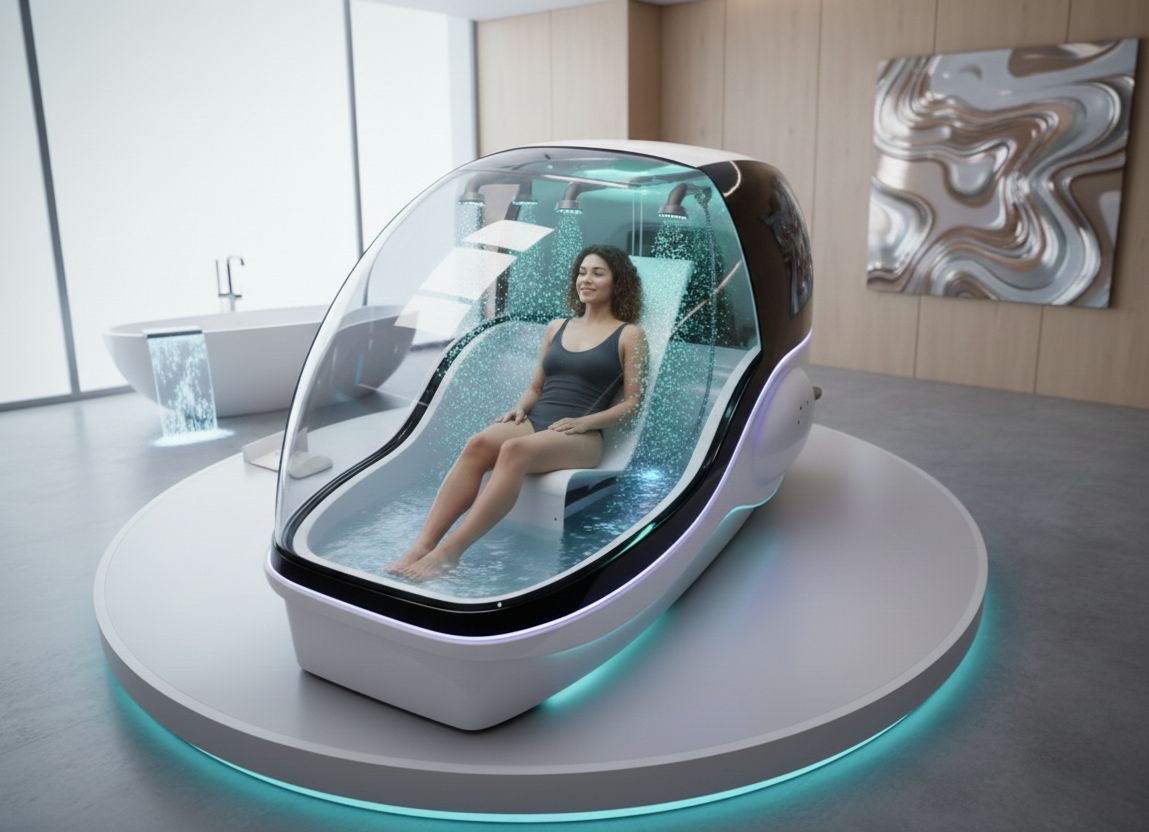
$385.000 Valued "Human Washing Machine" Launches in Japan
Japanese company Science Inc. has officially launched its innovative product, the Mirai Human Washing Machine, which was first unveiled to the public at the 2025 World Expo in Osaka. This high-tech, automated spa-capsule is capable of fully cleaning and drying a user from head to toe in just 15 minutes, requiring no physical effort. The user enters the comfortable capsule, which measures 2.5 meters in length and 2.6 meters in height, after which the cleansing is performed using microbubbles. These ultra-fine bubbles penetrate the skin's pores, effectively removing oil, dirt, and dead skin cells, all while the process is accompanied by relaxing music.
A company representative notes that the device not only cleanses the body but also "washes the soul." This innovation is also equipped with a sensor system that continuously monitors the user's vital signs. This significantly enhances the level of safety by preventing situations such as fainting or panic attacks. It is worth noting that this concept is not entirely new; its prototype was exhibited back in 1970 at the Osaka Expo by Sanyo Electric (now Panasonic Holdings). Yasuaki Aoyama, the President of Science Inc., who saw it in his youth, revived the idea by incorporating modern technology.
This exclusive device is hitting the market with a considerable price tag of 60 million Yen (approximately $385,000). This pricing strategy suggests that the product is aimed not at mass consumption, but rather at the commercial spa market. Consequently, the "Mirai" is expected to find its place primarily in high-end hotels, traditional Japanese baths (onsens), health resorts, and leisure areas. The company plans to release a limited run of only 40 to 50 units, the first of which has already been acquired by a Japanese hotel, with another 5 to 8 units reserved by other potential clients.
This initiative is not just about the function
of cleanliness; it also underscores Japan's ongoing interest in automated
systems and care robots, which are particularly crucial for its aging
population. This device—which washes, dries, and monitors safety—essentially
serves as a prototype for future automated elderly care systems and fully
automated domestic facilities. Despite the high price today, Science Inc.
maintains that as technology advances and the possibilities for mass production
increase, more affordable home versions may be released.
See the
source.
Related materials