Air Danshin Develops System That Levitates Houses During Earthquakes
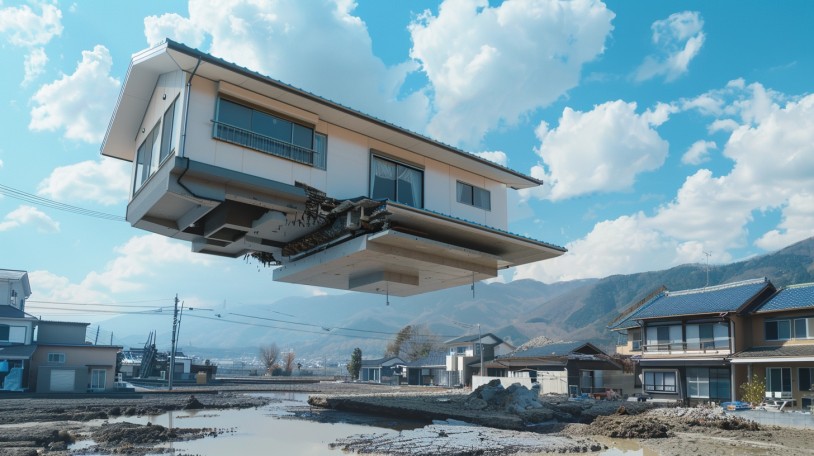
Japanese company Air Danshin has developed a seismic isolation system that lifts houses off their foundations during earthquakes, providing safety and peace of mind to residents living in earthquake-prone regions. The technology was invented by Shoichi Sakamoto, who has long been concerned with the safety of buildings during earthquakes.
The system is designed to function in a straightforward manner. At the core of this technology is an expandable, sliding air chamber that separates the house from its foundation. Within 0.5 to 1 second of detecting a quake, air from a storage tank fills the chamber, lifting the entire structure up to 1.18 inches (3 cm) off the ground. The house remains suspended until sensors determine that the shaking has stopped. To ensure reliability, the system is equipped with emergency batteries that keep it operational even during power outages, which are common during major seismic events.
Air Danshin claims that their system costs approximately one-third of traditional seismic isolation systems, making it an attractive option for both homeowners and businesses. The company has also developed larger versions of the system suitable for protecting facilities such as factories and laboratories. To prove the system's effectiveness, Air Danshin conducted a series of tests. During one such test, a full-scale house equipped with furniture, household items, and even a couple of glasses of wine was subjected to simulated tremors. In front of an audience of engineers and safety experts, the house smoothly lifted off its foundation, and not a single drop of wine was spilled.
Despite Air Danshin's system being an interesting
safety approach, experts like Deke Smith, Executive Director of the Building
Seismic Safety Council and the buildingSMART alliance in Washington, DC, have
pointed out some potential limitations. Smith notes that the system's
effectiveness may be limited to smaller earthquakes or those that involve
primarily lateral shaking. Larger earthquakes, which often involve more complex
and multi-dimensional movements, could still pose challenges. Additionally, the
first tremors of an earthquake are often the most destructive, and there is
concern that the airbag might struggle to inflate if the structure is already
damaged.
See the
source․
Related materials