String Theory: The Mathematical Nature of Cosmic Symphony
The Core Problem and Solution
When Einstein formulated the theory of relativity and Planck established the foundations of quantum mechanics, physicists found themselves in a paradoxical situation: these two fundamental theories could not be reconciled. String theory offers an elegant solution to this problem by reimagining the nature of particles.
The Nature of Strings and Their Vibrations
According to the theory, the fundamental components of the universe are not point particles but one-dimensional "strings." These string vibrations, occurring at the Planck length scale (10⁻³³ cm), generate everything we know—from electrons to gravitons. Each vibration frequency corresponds to a specific particle, just as different vibrations of a string create different notes.

The Theory of Multidimensional Spaces
One of the key ideas of the theory is the existence of ten or eleven dimensions. These additional dimensions are folded into a Calabi-Yau manifold—a complex mathematical structure that explains why we usually see only four dimensions. Imagine a two-dimensional circle drawn on paper, where at each point there exists such a small curved circle that it cannot be detected without special equipment.
Experimental Challenges
Despite its mathematical beauty, the theory still lacks experimental confirmation. Testing it requires Planck energy level experiments (10¹⁹ GeV), which is approximately 10¹⁵ times beyond the capabilities of the Large Hadron Collider. However, the theory has already led to the development of new branches of mathematics and contributed to the formulation of the holographic principle.
Inter-Physical Connections
String theory also suggests remarkable connections between different physical systems. For example, the AdS/CFT correspondence reveals that a gravitational field in anti-de Sitter space can be described by a quantum field acting in a space with one lower dimension. This holographic principle is similar to how complete information about a three-dimensional object can be preserved in its two-dimensional projection.
Conclusion
Looking at the night sky, we see stars, planets, and galaxies, but string theory offers a deeper picture—all of this consists of vibrating microscopic strings. Although we live in four dimensions (three spatial and one temporal), the theory suggests the existence of seven additional dimensions. If this theory is correct, it could become the unified key that explains all fundamental interactions in the universe—from gravity to quantum-level phenomena.
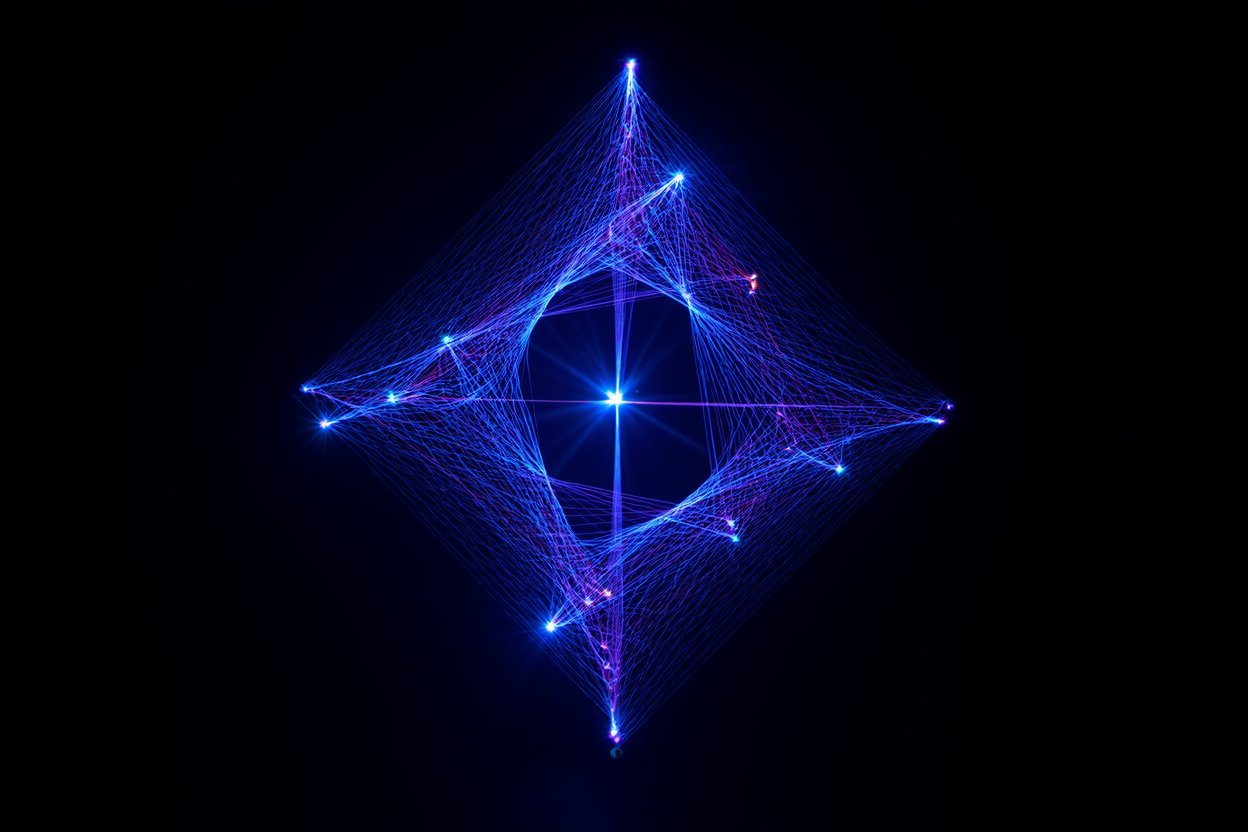
The main image of the article symbolizes: The geometric network of cosmic strings, showing how the interconnected vibrations of microscopic strings form the fundamental structure of the universe.
Author Gevorg Zadoyan.

Related materials