How Mathematics Unveils the Secrets of Our Plate
Introduction․
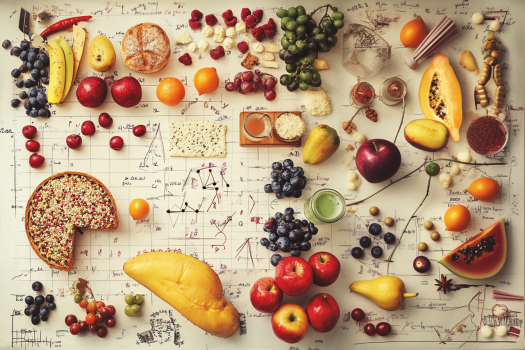
Have you ever wondered how that small number—the calorie count on a food package—relates to your health? Prepare to be amazed as we uncover the numerical secrets of the calorie world.
Interesting Facts․
Did you know that one gram of fat contains 9 calories, while the same amount of protein or carbohydrate contains only 4? These numbers can help you understand why it's so easy to "accumulate calories" with fatty foods. If you eat one kilogram of butter (hopefully, you won't), that would be 7,170 calories, enough to sustain you for about 3 days.
Imagine you enjoy a glass of wine every day. One glass (150ml) contains about 125 calories. Seems little, right? But let's multiply:
125 kcal x 7 days = 875 kcal per week
875 kcal x 52 weeks = 45,500 kcal per year
This is equivalent to about 5.8 kg weight gain over a year—just from one glass of wine daily.
Logarithmic Thinking․
Scientists have discovered that our body's metabolism follows a logarithmic curve. This means that losing weight becomes more difficult as you get closer to your target weight. If you consume 500 calories less than normal every day, you might lose about 1 kg in the first week, but only 0.7 kg the next week, even if you maintain the same regime.
Law of Energy Conservation․
The fundamental law of physics—the law of energy conservation—also works in our body. Every excess calorie that isn't spent turns into fat. 1 kg of body fat contains about 7,700 calories. So, if you eat just 100 calories more than you spend every day (for example, one banana), by the end of the year you'll have:
100 cal x 365 days = 36,500 cal = about 4.7 kg weight gain
Calorie counting might seem complicated, but it can also be fun. For example, if you like pizza, know that one slice of pizza (about 100 grams) contains an average of 250-300 calories. This means that to "burn" those calories, you'll need:
- 30 minutes of swimming
- 45 minutes of brisk walking
- 20 minutes of running
- 1 hour of yoga
The basic formula for weight management is:
Weight change = Calories consumed - Calories expended
This seems simple, but in reality, it involves many factors. For example, calories expended depend not only on physical activity but also on the body's basic metabolism, which is different for each individual. One kilogram of muscle tissue burns about 13 calories per day at rest, while the same amount of fat tissue burns only 4.5 calories.
Arithmetic of Thermogenesis․
The Thermic Effect of Food (TEF) is the calories that the body spends on digesting, absorbing, and using food. It accounts for about 10% of daily calorie expenditure. However, different foods have different TEF:
- Proteins: 20-30% (20-30 calories are spent on digestion from 100 calories of protein)
- Carbohydrates: 5-10%
- Fats: 0-3%
These numbers show why a high-protein diet can aid in weight loss.
Macronutrient Balance Problem․
Optimal diet planning can be viewed as a linear programming problem. For example:
Maximize: a(proteins) + b(carbohydrates) + c(fats)
Subject to: a + b + c = total calories
and a ≥ 10%, b ≥ 45%, c ≥ 20% of total calories
This approach allows creating personalized diets considering various constraints and preferences.
Conclusion․
Mathematics and calorie counting are closely intertwined. Uncovering the complex interactions between our body and food can help us make better decisions about our health and understand how small changes can lead to big results over time. Remember, every calorie is counted thanks to mathematics, which can be your ally on the path to a healthy lifestyle and building a healthy body and mind.
Related materials