The Digital Mathematician: AI's Venture into Uncharted Number Horizons
In recent years, artificial intelligence (AI) has emerged as a powerful tool in various fields, including mathematics. Researchers are increasingly leveraging AI techniques to explore and potentially solve long-standing mathematical problems that have puzzled brilliant minds for centuries. One such problem is the famous Riemann Hypothesis, which has remained unproven for over 150 years.
The Riemann Hypothesis: A Mathematical Enigma
The Riemann Hypothesis, proposed by Bernhard Riemann in 1859, is considered one of the most important unsolved problems in pure mathematics. It concerns the distribution of prime numbers and has far-reaching implications in number theory and related fields. The hypothesis states that all non-trivial zeros of the Riemann zeta function have a real part equal to 1/2.
Researchers are employing various AI techniques to gain insights into the Riemann Hypothesis
Machine Learning for Pattern Recognition
AI algorithms are being used to analyze vast amounts of data related to the zeros of the Riemann zeta function. By identifying patterns and correlations, these algorithms might provide new perspectives or suggest promising avenues for formal proof. In 2019, a team led by Yoshua Bengio at the University of Montreal used deep learning to study the Riemann zeta function. Their neural network learned to predict the locations of zeros with high accuracy, suggesting that AI could potentially uncover hidden structures in the function's behavior.
Neural Networks for Function Approximation.
Neural networks are being trained to approximate the behavior of the Riemann zeta function. This approach could potentially lead to a better understanding of its properties and the nature of its zeros. In 2021, researchers from the University of Nottingham and the Technical University of Denmark used neural networks to approximate the Riemann zeta function with unprecedented accuracy. Their work, published in the journal Physical Review Letters, demonstrated that AI could handle complex mathematical objects efficiently.
Automated Theorem Proving.
AI-powered theorem provers are being developed to assist mathematicians in constructing formal proofs. While not yet capable of proving the Riemann Hypothesis independently, these tools can help verify intermediate steps and explore logical consequences of known results. The Lean theorem prover, developed by Microsoft Research, has been used to formalize significant portions of mathematics. In 2020, a team led by Kevin Buzzard at Imperial College London used Lean to verify a key step in the proof of Fermat's Last Theorem, demonstrating the potential of AI in rigorous mathematical verification.
The Collatz Conjecture.
AI is being used to search for patterns in the behavior of numbers under the Collatz sequence, potentially providing insights into this notoriously difficult problem.
In 2019, a paper published in the journal Nature described how researchers used a neural network to discover a previously unknown relationship in the Collatz conjecture, demonstrating AI's ability to uncover new mathematical insights.
Algebraic Geometry.
Machine learning algorithms are assisting in the classification of algebraic varieties, a task that often requires intricate calculations and pattern recognition.
Researchers at the Max Planck Institute for Mathematics in the Sciences have used machine learning to classify Calabi-Yau manifolds, complex geometric objects important in string theory and algebraic geometry. Their work, published in Physical Review Letters in 2021, significantly accelerated the classification process.
Knot Theory.
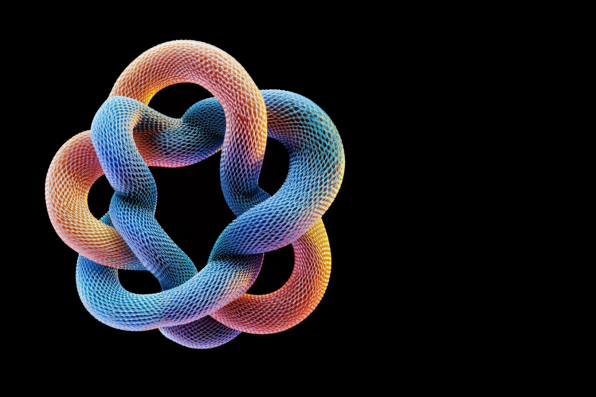
AI is helping to classify and analyze complex knots, potentially leading to breakthroughs in topology and related fields.
In 2020, researchers from the University of Liverpool and the Technical University of Berlin developed an AI system that could recognize and classify knots with high accuracy. Their work, published in Scientific Reports, has implications for understanding protein folding and other physical phenomena.
Challenges
While AI shows promise in mathematical exploration, several challenges remain:
Interpretability.
Many AI models operate as "black boxes," making it difficult to translate their insights into rigorous mathematical proofs.
Terence Tao, a Fields Medalist , has cautioned that while AI can suggest patterns and hypotheses, translating these into formal proofs remains a significant challenge requiring human insight.
Formal Verification. Results obtained through AI methods still require formal verification to be accepted as mathematical proofs. The Four Color Theorem, first proved in 1976 with the help of computer calculations, took decades to be fully accepted by the mathematical community. This highlights the ongoing challenge of integrating computational methods into traditional mathematical proof. Computational Limitations. Some mathematical problems involve calculations beyond the capabilities of current computing systems, limiting the effectiveness of brute-force AI approaches. The Boolean Pythagorean Triples problem, solved in 2016 using a supercomputer, required analysis of 200 terabytes of data. This illustrates the computational challenges faced in certain mathematical problems, even with advanced AI techniques. The Future of AI in Mathematics. As AI techniques continue to evolve, their role in mathematical research is likely to grow. While it's unlikely that AI will replace human mathematicians, it is becoming an increasingly valuable tool for exploration, hypothesis generation, and proof assistance. Sir Michael Atiyah, before his passing in 2019, suggested that the future of mathematics lies in a symbiosis between human intuition and machine computation. He believed that AI could help mathematicians explore vast spaces of mathematical structures that are beyond human capability alone. The integration of AI into mathematical research represents an exciting frontier, promising new insights and methodologies for tackling some of the most challenging problems in the field. As this synergy between human and artificial intelligence continues to develop, we may be on the cusp of a new era in mathematical discovery, potentially leading to breakthroughs in long-standing problems like the Riemann Hypothesis and beyond.
Related materials