The Fourth State of Matter: The Amazing World of Plasma
Introduction
When we think about matter, we usually imagine three main states: solid, liquid, and gas. However, scientists have long discovered a fourth state of matter called "plasma". Although it may seem exotic, plasma is actually more common in the universe than the other three states of matter combined.
1. What is plasma?
Plasma is an ionized gas in which electrons are separated from atoms, creating a mixture of free electrons and ions. Imagine plasma as a "super-gas". If we heat water, it will turn into steam - a gas. And if we continue to heat or add energy to the gas, it will turn into plasma. Unlike ordinary gas, plasma is electrically conductive and responds strongly to electromagnetic fields.
The uniqueness of plasma lies in the fact that it can exist in a very wide temperature range, from room temperature (for example, in fluorescent lamps) to millions of degrees (as inside stars). This diversity allows plasma to have numerous applications, from technology to astrophysics.
2. Formation of plasma
Plasma is formed when sufficient energy is supplied to a gas to strip electrons from atoms. This can occur under conditions of high temperatures, strong electric fields, or intense illumination.
On the surface of the Sun, the temperature is so high (about 5500°C) that atoms are constantly in an ionized state, creating a huge ball of plasma. On Earth, plasma can occur during electrical discharges, such as lightning.
In laboratory conditions, plasma can be created in various ways. For example, radio-frequency plasma is created by applying high-frequency electromagnetic waves to a gas. This method is widely used in semiconductor production.
3. Properties of plasma
Plasma has a number of unique properties that distinguish it from other states of matter:
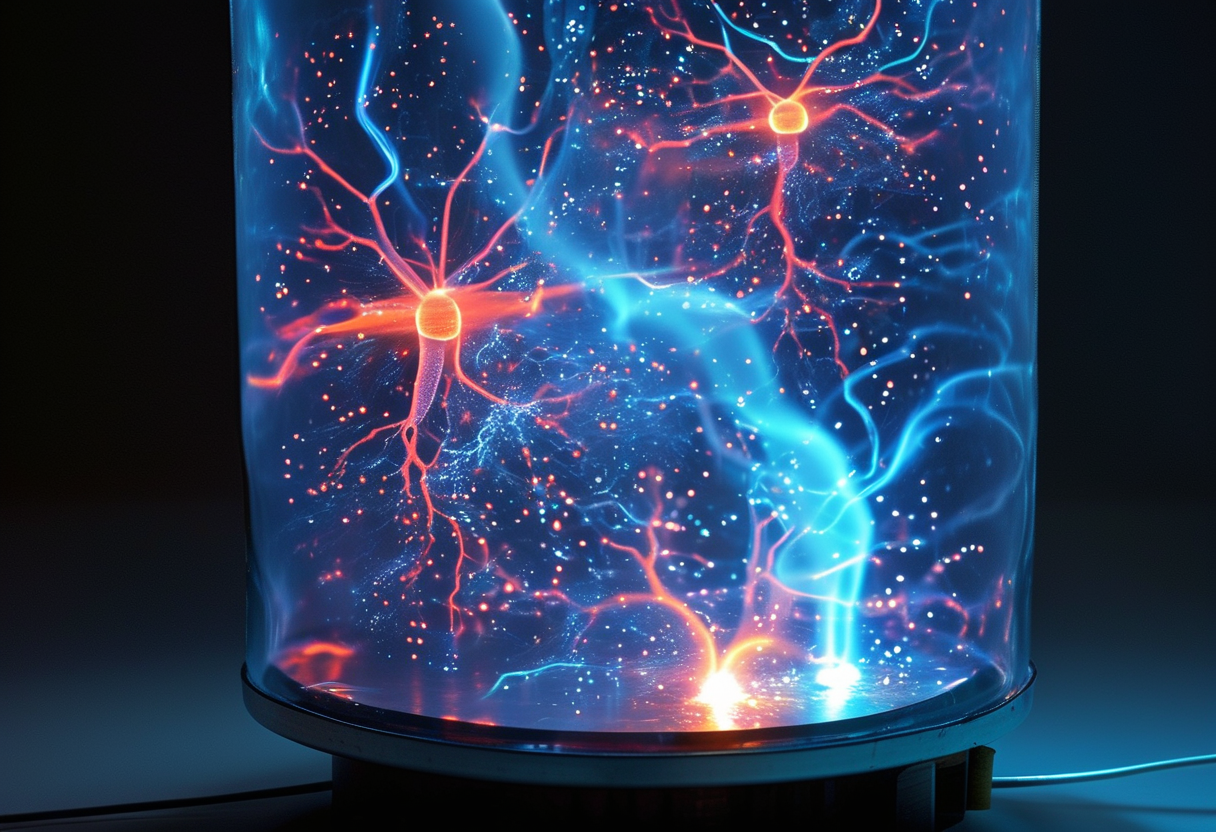
High electrical conductivity: Due to the presence of free electrons, plasma is an excellent electrical conductor. This allows plasma to respond quickly to electric fields.
Strong interaction with magnetic fields: The charged particles in plasma strongly interact with magnetic fields. This is used, for example, in tokamaks to contain plasma.
Collective behavior: Plasma particles often move together as a whole in response to external influences. This leads to complex and interesting phenomena, such as plasma waves.
Thermal properties: Plasma can reach extremely high temperatures while maintaining its structure. This is important in nuclear fusion research.
4. Plasma in nature
Plasma is widespread in the universe and occurs in various phenomena on Earth.
Stars, including our Sun, are mainly composed of plasma. The corona of the Sun, its outer layer, is a vast region of plasma with temperatures reaching millions of degrees.
On Earth, we can see plasma in the form of lightning. Lightning represents a powerful electrical discharge that creates a short-lived but intense column of plasma.
The Northern Lights (aurora) are also a manifestation of plasma. They occur when solar wind particles interact with the Earth's atmosphere, creating beautiful luminous displays.
The Earth's ionosphere, the upper layer of the atmosphere, is also a form of plasma. It plays an important role in radio communication, reflecting certain radio waves and allowing them to propagate over long distances.

5. Applications of plasma in technology
Plasma is widely used in modern technologies.
"Plasma TVs" and "fluorescent lamps" use plasma to produce light.
Plasma welding uses the high temperature of plasma to join metals.
Plasma is used in semiconductor production for surface treatment.
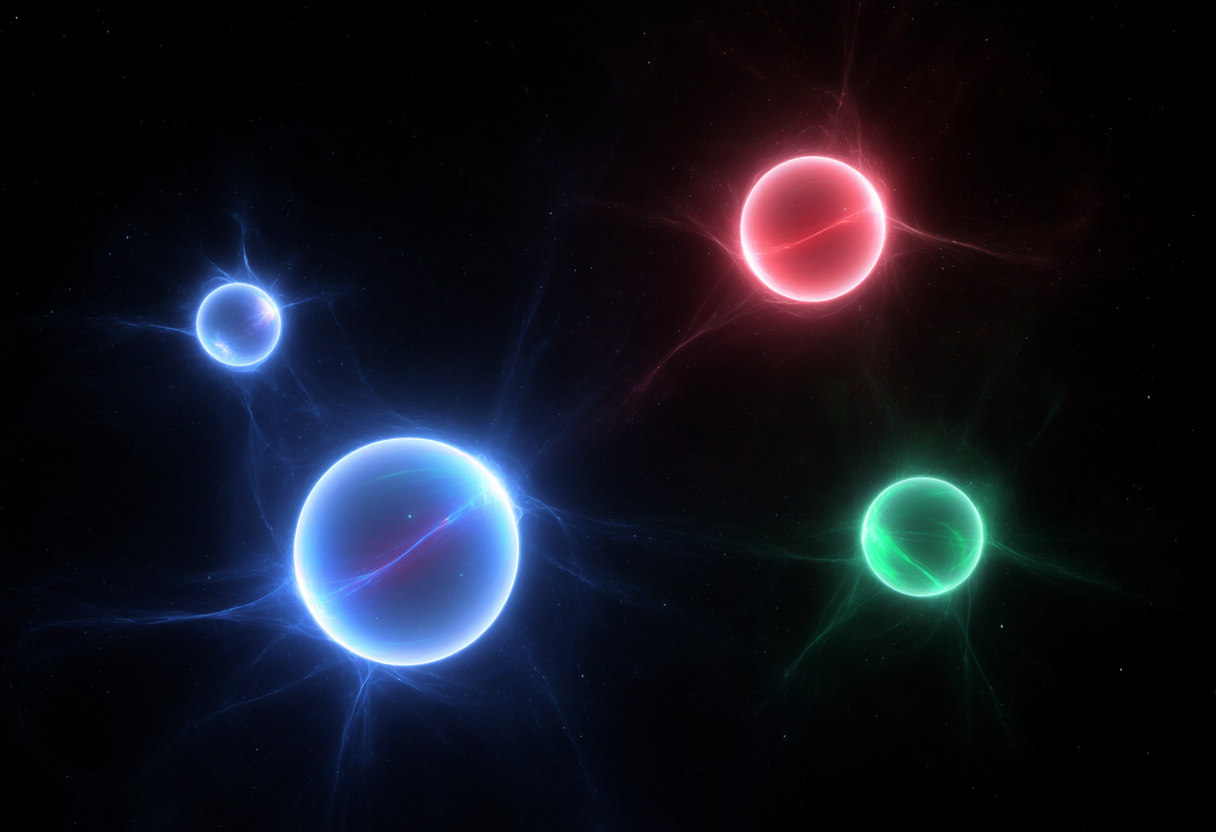
6. Plasma and nuclear fusion Nuclear fusion promises clean, inexhaustible energy. Tokamaks use magnetic fields to contain high-temperature plasma. Recently, the first "net positive energy" fusion reaction was achieved at the National Ignition Facility (USA). 7. Plasma research and the future Plasma physics continues to be an active field of research. Scientists are exploring new applications of plasma, such as: Plasma engines for space exploration The use of plasma in medicine for sterilization and wound treatment New types of plasma displays and lighting devices Conclusion Plasma, as the fourth state of matter, not only dominates the universe but is also becoming an increasingly important part of our everyday life. It opens up new possibilities in the fields of energy, technology, and science. Plasma research can offer solutions to some of the biggest challenges of our time, including clean energy production and space exploration. As we continue to uncover the secrets of plasma, we will undoubtedly discover new and exciting applications for this amazing state of matter. The main image of the article symbolizes plasma, the fourth cosmic state.

Related materials