The Mystery of Black Holes: Latest Secrets of the Most Enigmatic Objects in the Universe
Introduction
Black holes, the most mysterious objects in the universe, have captivated scientists and the public for centuries. In this article, we will uncover the secrets of black holes by exploring the latest theories and observations.
1.Fundamental Properties of Black Holes
Black holes are cosmic objects with such strong gravitational fields that not even light can escape them. They form when massive stars collapse at the end of their lives. The boundary of a black hole is called the "event horizon": once crossed, nothing can return.
Another interesting property of black holes is time dilation. According to Einstein's theory of relativity, time passes more slowly in strong gravitational fields. Near a black hole, this effect is so strong that time practically stops from the perspective of an outside observer as one approaches the event horizon.
Moreover, black holes can rotate, leading to the formation of an ergosphere - a region outside the event horizon where objects are forced to rotate with the black hole. This phenomenon can result in energy outflow known as the Penrose process.
2.Types of Black Holes
Scientists distinguish three main types of black holes: stellar-mass, supermassive, and intermediate-mass. Supermassive black holes, found at the centers of galaxies, can have millions or billions of solar masses.
Stellar-mass black holes form when massive stars (approximately 20 solar masses or more) exhaust their nuclear fuel and collapse. They typically have 5 to 100 solar masses.
Intermediate-mass black holes are a relatively newly discovered category. They range from 100 to 100,000 solar masses and may form in the centers of small galaxies or in stellar clusters. Scientists are still trying to understand their formation mechanisms.
Supermassive black holes, located at the centers of galaxies, likely formed in the early universe and grew by consuming surrounding matter and merging with other black holes. The black hole at the center of our Milky Way galaxy, Sagittarius A*, has about 4 million solar masses.
3.Methods of Detecting Black Holes
Black holes are invisible, but scientists can detect them through indirect methods. For example, by observing their gravitational effects on nearby stars or by detecting X-ray radiation emitted when a black hole "swallows" surrounding matter.
4.Recent Observations and Discoveries
In 2019, scientists photographed a black hole for the first time - the M87* supermassive black hole, located 55 million light-years away from us. This historic event revolutionized astrophysics by allowing direct study of these mysterious objects.
In 2022, the international Event Horizon Telescope (EHT) collaboration released an image of Sagittarius A*, the black hole at the center of our galaxy. This achievement allowed comparison of two different-sized black holes and confirmed that they conform to Einstein's general theory of relativity.
Additionally, in 2015, the LIGO (Laser Interferometer Gravitational-Wave Observatory) experiment detected gravitational waves for the first time, produced by the merger of two black holes. This discovery opened a new era in astrophysics, allowing the study of the universe through gravitational waves.
In recent years, scientists have also discovered "ultra-massive" black holes whose masses exceed the limits predicted by theory. These discoveries are forcing a revision of models of black hole formation and evolution.
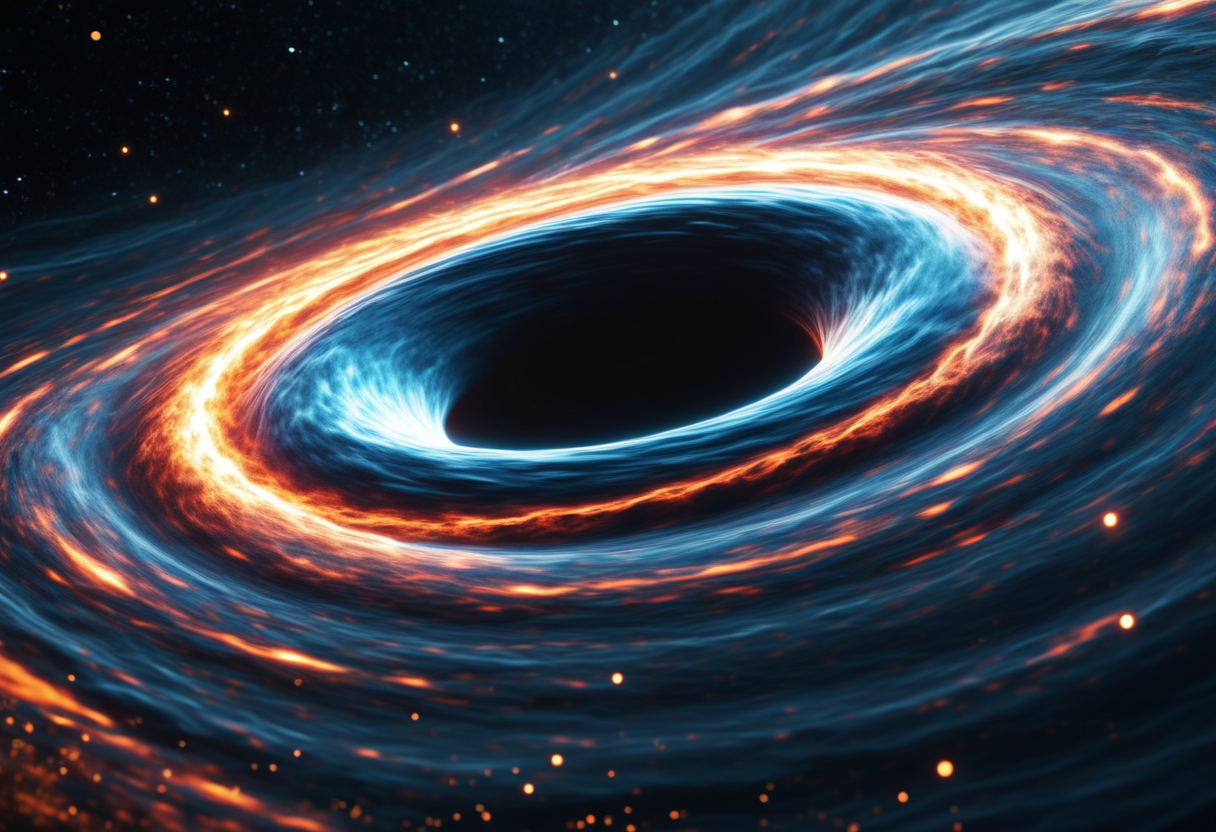
5.Contemporary Theories About Black Holes Famous physicist Stephen Hawking proposed a theory suggesting that black holes can "evaporate" by emitting radiation. This phenomenon, known as Hawking radiation, creates a link between quantum mechanics and gravity. Supermassive black holes play an important role in the formation and development of galaxies. They contribute to star formation and regulate galaxy growth. Some scientists believe that black holes may even be connected to other universes. 7.Future Research Directions Scientists continue to develop new technologies and equipment to study black holes in more detail. Future research may help uncover the secrets of the origin and evolution of the universe. Conclusion Black holes continue to inspire and amaze us. Their study not only reveals the secrets of the universe but also pushes us to reconsider our understanding of space, time, and matter. Each new discovery brings us one step closer to a deeper comprehension of the universe. The main image of the article symbolizes a dramatic view of a black hole in space.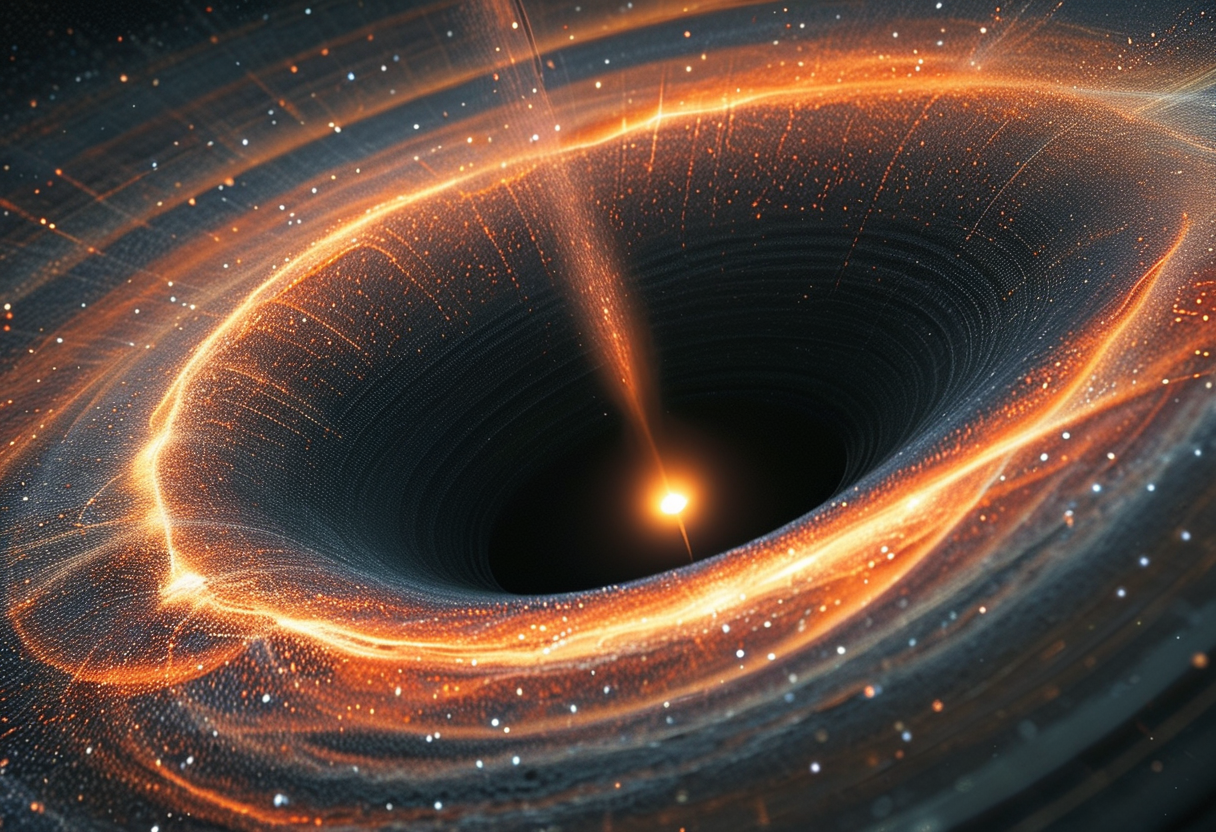
6.The Role of Black Holes in the Evolution of the Universe

Related materials