"God particle". The Essence of the Higgs Boson Discovery and Its Significance for Physics
Introduction
The discovery of the Higgs boson in 2012 is considered one of the most important achievements in modern physics. In this article, we will discuss the significance of this discovery for physics and science in general.
1. The Essence of the Higgs Boson and Its Role
The Higgs boson is an elementary particle named after British physicist Peter Higgs. It is often called the "God particle," although scientists avoid this expression. The uniqueness of the Higgs boson lies in its connection to the Higgs field, which, according to theory, fills the entire universe.
Imagine the Higgs field as a vast snow field. Different particles, moving through this field, interact with it in different ways. Some particles, like skiers, glide over the field without much interaction. These particles, such as photons, have no mass. Other particles, like those walking in heavy boots, leave deep tracks in the snow and move with difficulty. These particles have large mass. The Higgs boson can be thought of as a "wave" or "excitation" of this snow field.
Thus, the existence of the Higgs field and the Higgs boson explains how elementary particles acquire their mass, which is fundamental to understanding the structure of our universe.

2. Theoretical Foundations of the Higgs Boson
The Standard Model is one of the fundamental theories in physics that describes elementary particles and their interactions. However, this model couldn't explain how particles acquire their mass. To solve this problem, in 1964, Peter Higgs and other scientists proposed a mechanism that later became known as the Higgs mechanism.
Imagine that the entire universe is filled with an invisible field - the Higgs field. Particles, moving through this field, interact with it and acquire mass. The stronger this interaction, the greater the mass of the particle.
3. Experimental Discovery of the Higgs Boson
To confirm the existence of the Higgs boson, it was necessary to build the world's most powerful particle accelerator - the Large Hadron Collider. This enormous device, located on the border of Switzerland and France, allowed scientists to collide protons at nearly the speed of light and create conditions that existed at the moment of the universe's creation.
On July 4, 2012, the ATLAS and CMS experiment teams announced the discovery of the Higgs boson. This led to the awarding of the Nobel Prize to François Englert and Peter Higgs in 2013.

4. Study of the Higgs Boson Properties
After the discovery, scientists began to study the properties of the Higgs boson in detail. It was found that it has a mass of about 125 GeV/c², which corresponds to a particle about 130 times heavier than an atomic nucleus. The Higgs boson is very unstable and exists for only 10^-22 seconds before decaying into other particles.
5. The Significance of the Higgs Boson for the Standard Model
The discovery of the Higgs boson confirmed the validity of the Standard Model and filled its last gap. It explained how elementary particles, such as electrons and quarks, acquire their mass. This allowed for a better understanding of the structure and development of the universe.
6. The Impact of the Higgs Boson Discovery on Other Areas of Physics
The discovery of the Higgs boson had an impact on other areas of physics as well. For example, it can help understand the nature of dark matter, which makes up a large part of the universe's mass. In addition, the study of the Higgs boson can provide clues about theories of supersymmetry and extra spatial dimensions.
7. Open Questions and Future Research Related to the Higgs Boson
Despite the discovery of the Higgs boson, many questions remain unanswered. For example, scientists are trying to understand the exact shape of the Higgs field and its stability. They are also studying the self-interaction of the Higgs boson, which could reveal new physics beyond the Standard Model.

8. Technological and Social Impact of the Higgs Boson Discovery
The search for the Higgs boson led to the development of particle accelerators and detectors. It also stimulated advances in data analysis and machine learning methods. Furthermore, this discovery inspired international scientific collaboration and increased public interest in physics.
Conclusion
The discovery of the Higgs boson not only filled the last gap in the Standard Model but also opened new horizons for the further development of physics. It showed how theoretical physics can guide experimental research and lead to revolutionary discoveries. The study of the Higgs boson continues to be one of the most important directions in modern physics and promises new insights about our universe.
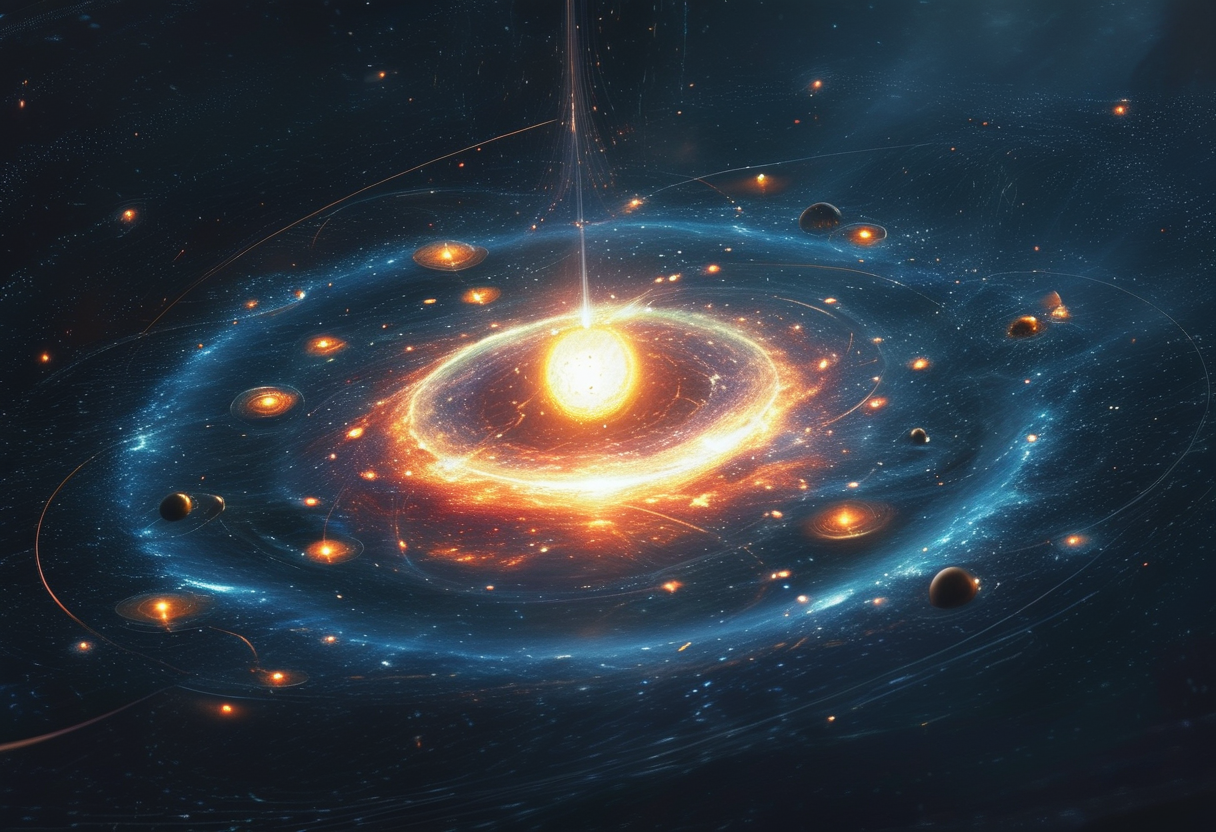
The main image of the article symbolizes the central role of the Higgs boson in understanding the universe and its connection to other particles.

Related materials