How a Robot Learned to Rule the Ping-Pong Table
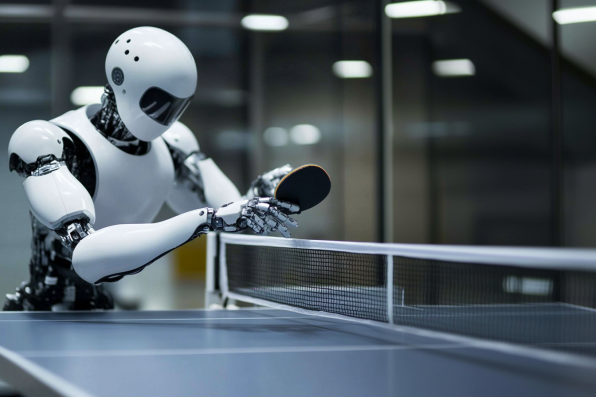
Do you fancy your chances of beating a robot at a game of table tennis? Google DeepMind has achieved a significant milestone in robotics and artificial intelligence by training a robot to play table tennis at a competitive amateur level. According to an article published by MIT Technology Review, this marks the first instance of a robot being taught to play a sport against humans at a human-comparable level.
The robotic system, consisting of an arm equipped with a 3D-printed paddle, managed to win 13 out of 29 games against human opponents of varying skill levels. While the robot consistently defeated beginners and won 55% of matches against amateur players, it struggled against advanced competitors, losing all games at that level.
Pannag Sanketi, a senior staff software engineer at Google DeepMind who led the project, expressed surprise at the robot's performance, noting that it exceeded their initial expectations. The research team employed a two-part approach to train the system:
1. Computer simulations to master hitting skills
2. Fine-tuning using real-world data for continuous improvement
The robot uses cameras to track the ball's position and a motion capture system to analyze its opponent's playing style. This data is then fed back into the simulation, creating a continuous learning loop that allows the robot to adapt its tactics during matches.
Despite its impressive performance, the system has limitations. It struggles with very fast or low balls, as well as those hit beyond its field of vision. Additionally, the robot has difficulty with spinning balls due to its inability to directly measure spin.
Experts in the field, such as Chris Walti, founder of robotics company Mytra, highlight the challenges of simulating real-world conditions accurately. However, they acknowledge the potential of this research for advancing robotics in various applications beyond sports.
Interestingly, human players reported enjoying their matches against the robotic arm, with some advanced players even expressing interest in using it as a training partner.
This breakthrough in table tennis playing robots represents a step towards creating more versatile and adaptable robotic systems that could potentially be applied in real-world environments like homes and warehouses.

Related materials